New
information acquired after the publication of the 3 volume edition of
A WHO'S
WHO OF TUDOR WOMEN
ISABEL AGARD (d. 1520+)
James Taffe in Accounting for
Anne identifies Isabel Stonor as Mother of Maids at the end of 1539 when
she was paid £5/quarter.
MARY AUCHER
According to Sylvia Barbara
Soberton, the stories associated with a Mary Orchard were a Victorian
invention.
CATHERINE
BLOUNT (c.1518-February 25, 1558/9)
According
to Rosemary Griggs's
Queen Elizabeth I's Governess: The Real Kat Ashley, in December 1549, after meeting her husband at the home of John
Stenning, Kat Astley went with Stenning's wife to Lady Berkeley's house in
Fleet Street to meet with other advocates of Protestant reform, including Kat's
sister, Joan Denny, Sir Peter Carew, Sir Gawen Carew, and George Carew.
ANNE BOLEYN
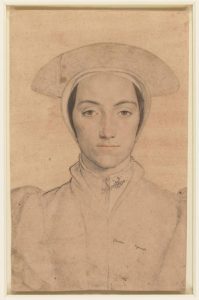
Karen L. Davies, et al facial
recognition study argues that this is Anne Boleyn, not "unknown
woman."
MARY BOLEYN
Sylvia Barbara Soberton's Mary
Boleyn which debunks most of the scandal associated with Mary. She
speculates Mary Boleyn, not Anne, was sent first to Margaret of Austria's court
and then to Mary Tudor in France and came home with Mary Tudor, but admits she
is "impossible to locate" between 1515 an 1520. She finds no certain
date for her affair with the king, but argues it took place before her
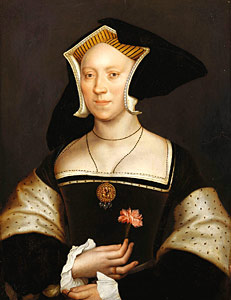
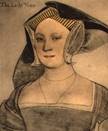
marriage. Karen L. Davies, et al facial recognition study argues that the
portrait below shows Mary Boleyn, not Elizabeth Cheney, Lady Vaux.
DOROTHY BROADBELT
Rosemary Griggs, in Queen
Elizabeth I's Governess: The Real Kat Ashley, suggests that Dorothy and
"Jane Broadbent" may have been sisters.
CATHERINE BROUGHTON HOWARD
Sophie Bacchus-Waterman's Elizabeth
Boleyn: The Life of the Queen's mother gives the date of her burial in
Lambeth as 1535.
MARGARET BUTLER BOLEYN
Sophie Bacchus-Waterman's Elizabeth
Boleyn: The Life of the Queen's mother states that her mental illness was first
recorded in Sept. 1519 and that she was living at Hever by 1526. Sylvia Barbara
Soberton's, Mary Boleyn says Thomas Boleyn arranged for her to receive
an income of 400 marks/year from her Ormond inheritance. She was described in
her inquisition post mortem as "lunatic, frenetic, insane, and not
of sound mind," although she had lucid intervals. Dr. Claire Martin in Heirs
of Ambition suggests she suffered from bipolar disorder.
CATHERINE CAREY
James Taffe in Accounting for
Anne lists her as a maid of honor to Anne of Cleves. She received a gift of
£15 one week before her marriage to Francis Knollys.
MARGARET CARY
Sylvia Barbara Soberton's, Mary
Boleyn says she was born November 30, 1564.
PHILADELPHIA CAREY
Sylvia Barbara Soberton's, Mary
Boleyn says she was born December 21, 1563.
JOAN CHAMPERNOWNE
According to Rosemary Griggs, in Queen
Elizabeth I's Governess: The Real Kat Ashley, Joan was one of two sisters with
the same first name and was the younger of the two, born c. 1513. Her sister,
Katherine Champernowne, the subject of Griggs's biography, was also one of two
sisters with the same first name and was older than Joan. Griggs gives the date
of Joan's marriage license from the Archbishop of Canterbury as February 4,
1538. In that same month Henry VIII granted Cheshunt and other manors to
"Anthony Denny and Joan Champernowne, one of the daughters of Sir Philip
Champernowne, whom the said Anthony is going to marry." In 1551/2, while
Joan was in litigation over her husband's estate, Princess Elizabeth sent her a
gift of £100. In May 1553, Joan's sister Kate and her niece, Elizabeth
Budockside, were called to Cheshunt to witness Joan's will. She died on May 23
and left many bequests of jewelry.
KATHERINE CHAMPERNOWNE (d. July 18,
1565)
Rosemary Griggs, in Queen
Elizabeth I's Governess: The Real Kat Ashley presents evidence that Katherine
Champernowne was one of two daughters of Sir Philip Champernowne and Catherine
Carew with that name. She also had two sisters named Joan, one of whom married
Anthony Denny. Their father (b. 1479) died on August 2, 1545. His will, made
two days earlier, named his daughter Katherine and her uncle, George Carew (a
priest) as joint executors should his wife be unable to act as executrix. His
inquisition post mortem in November 1545 identified Katherine Champernowne as
Sir Philip's eldest daughter. Griggs suggests that Kat married John Astley
before the end of that year and soon after was named Lady Mistress of
Elizabeth's household, a position that traditionally went to a married woman.
In 1551-2 her salary for a half year was £7 15s (roughly £1,373 in 2026).
Griggs theorizes that if the Maundy Thursday miniature by Lavina Teerlinc was painted in before 1565, then the woman holding
the queen's train is most likely Kat Astley. In 1561, after her husband was
dismissed from court over his part in advancing the suit of the King of Sweden,
Kat left court for six weeks. She went to her sister, Elizabeth (d. 1574),
widow of Archdeacon John Pollard, at The Slade, near Cornwood,
Devon, the home of Elizabeth's son, Philip Cole. In July of the following year,
Kat and Dorothy Broadbelt wrote to a former Swedish ambassador to England in support
of the Swedish match. By the spring of 1564, aged over sixty, Kat's health was
failing and she did not accompany the queen on progress that summer. I highly
recommend this biography, which contains many more carefully researched
details.
KATHERINE CHAMPERNOWNE (1519-1594)
Katherine Champernowne was the
second of two daughters named Katherine born to Sir Philip Champernowne and
Catherine Carew.
CHRISTINA OF DENMARK (1522-1590)
According to Jan-Marie Knights in Anne Boleyn's First
Love: The Life of Henry Percy (which has an extensive bibliography but no
footnotes or index), Christina first visited England in 1523, together with her
parents, the exiled King Christian II of Denmark and Sweden and Isabella of
Austria, daughter of King Philip I and Queen Joanna of Castile (Katherine of
Aragon's sister) and niece of Charles V. The retinue also included her siblings,
John and Dorothea, four gentlewomen, and forty other retainers. They hoped to
find support for Christian's restoration to the throne. Arriving at Dover on
June 15, they were escorted to Greenwich by the earl of Devon and the bishops
of Exeter and Rochester. They were entertained daily at court but housed at
Bath Place until they left in the first week of July.
MARTHA DENNY
James Taffe in Accounting for
Anne says Wymond Carew, Anne of Cleves's receiver general, stayed on with
his wife after the annulment. He intercepted Anne's letters for the king, after
which Anne accorded him and his wife less respect than she had for her steward,
Jasper Horsley, and his wife. Carew complained of this in a letter to John
Gates.
ELIZABETH DONNE
James Taffe in Accounting for
Anne identifies Elizabeth as the wife of Sir Thomas Dennis/Denys,
chamberlain to Anne of Cleves. Elizabeth gave Anne one of her own greyhounds (Anne
had several, plus other animals).
JACQUENETTA DUTWITE
(c.1550-1611)—her date of birth should be changed to c.1548
According to Eleanor Muncy March,
who is researching her life, her name is spelled Jacqueline in wills and her
father's surname is sometimes spelled Duthit. He died
in May 1591. She and Thomas Vautrollier had six sons: Simon (b.1565/6), Manassie (b. 1568-9), Thomas (1571-71), Thomas (1575-1608),
Daniel, and James (b.1583) but there is no listing for any daughters, casting doubt
on the theory that a daughter named after her mother was the one who married
Richard Field. That marriage took place in April 1589, not January. Their son
Richard was baptized December 1, 1590. See also Valerie Wayne's "The Labours of Jacqueline du Thait Vautrollier
Field" in Women's Labour and the History of the Book and the entry Wayne
wrote for the DNB. Wayne points out that, as aliens, the Vautrolliers did not have full rights with the Stationer's Company,
and that this was what prevented Jacqueline from continuing the business as a
widow.
ELIZABETH FITZGERALD (1527-March
1589/90)
Rosemary Griggs, in Queen
Elizabeth I's Governess: The Real Kat Ashley suggests that Elizabeth
accompanied her mother to the household of Princess Mary and Princess Elizabeth
before later joining Princess Mary's household.
DOROTHY FITZHERBERT (d. 1557+)
The date if her death should be
changed to 1564+ James Taffe in Accounting for Anne identifies Dorothy's
husband as John (d.1542), son of Anthony Wingfield of Letheringham,
and reports that they were engaged to be married by the spring of 1538, but
that Dorothy had to go to ecclesiastical court to force him to go through with
the marriage. When they decided in her favor, John appealed to the king and his
father petitioned Lord Cromwell, but Dorothy prevailed. They married sometime
after September 1539. She was paid wages of 50s/quarter as a gentlewoman in the
household of Jane Seymour and these payments continued after the queen's death.
She was in the household of Anne of Cleves and when Anne was replaced by
Catherine Howard, Anne asked that Dorothy stay with her. In 1541, John and
Dorothy petitioned the king to lease the former priory of Woodbridge, Suffolk.
In 1548, when Woodbridge was to be sold, Dorothy petitioned Anne Stanhope
Seymour, countess of Hertford. Her letter is included in Taffe's book. Dorothy was
to live there with the reversion to the Crown upon her death (she had no
children). Anne of Cleves's will named Dorothy first among those receiving
bequests. In addition to the sum she received as chief gentlewoman, she was
left an additional £20. In 1564, she was still living when the reversion was
sold to Thomas Seckford.
BRIDGET FOGGE
James Taffe in Accounting for
Anne clarifies that Bridget Fogge was not Mother Lowe, Mother of Maids under
Anne of Cleves. That lady was from Cleves and is recorded on May 22, 1540 as
being one of several "Dutch maids" who wanted to return home. While
waiting for the king's permission, they were housed in the Tower of London,
which reportedly terrified Mother Lowe. Sir William Paget was assigned to
escort them home and leave to depart was granted by June 1540. The final
license was approved by Catherine Howard.
ALYS GAGE
James Taffe in Accounting for
Anne suggests that Alys was a lady of the privy chamber to Anne of Cleves
but left Court in February to recover from a sudden illness and died 31 March
1540.
DOROTHY GREY (c.1480-1553)
Rosemary Griggs, in Queen
Elizabeth I's Governess: The Real Kat Ashley, reports that Dorothy was a
supporter of Lord Admiral Thomas Seymour and on one occasion her insistence on
advocating for his marriage to Elizabeth Tudor nearly resulted in her eviction
from her second husband's house.
ELIZABETH GREY (c.1497-1548+)
Rosemary Griggs, in Queen
Elizabeth I's Governess: The Real Kat Ashley reports that the earl of
Kildare had lost a limb due to a battle wound and that he was arrested for
corruption. She identifies Elizabeth as the "Lady Garrett" sent to
serve Mary and Elizabeth Tudor and says that she brought her daughter, Elizabeth
Fitzgerald with her.
ELIZABETH
GREYSTOKE (July 10,
1471-August 14, 1516)
According to Jan-Marie Knights in Anne Boleyn's First
Love: The Life of Henry Percy (which has an extensive bibliography but no
footnotes or index), Elizabeth, at seventeen, "stole out one night from
Lord Clifford's castle of Brougham" to elope with Thomas, Lord Dacre, who
had just attained his majority.
ELEANOR
HARBOTTLE (1504-May 18, 1566) Eleanor Harbottle was the
daughter of Sir Guiscard (misspelled in her entry) Harbottle of Horton,
Northumberland (January 6, 1485-September 9, 1513). According to Jan-Marie
Knights in Anne Boleyn's First Love: The Life of Henry Percy (which has
an extensive bibliography but no footnotes or index), she married Sir Thomas
Percy (c.1504-x. June 2, 1537) shortly after his father's death in 1527. His
brother, the new earl granted him the manors of Kildale
and Battersby in Yorkshire and in 1529 also granted him an annuity of 100 marks
from the manors of Prudhoe, Corbridge, and Langley. After her husband's
execution, their children were removed from Prudhoe and placed in the custody
of Sir Thomas Tempest. In March, Lady Percy, who by indenture was granted her
late husband's goods, went in person to take the inventory of those goods to
Lord Cromwell. Knights says that the duke of Norfolk wrote to Cromwell that "she
was a good woman and had obeyed him in all things."
ELIZABETH HASTINGS
(c.1486-1504/5)
According to Jan-Marie Knights in Anne Boleyn's First
Love: The Life of Henry Percy (which has an extensive bibliography but no
footnotes or index), the earl of Northumberland (d.1527) "took away"
the daughter of Sir John Hastings of
York, an heiress who was a royal ward, in 1502, and she died "through his
default." (quotes are from a memorandum in the chamber accounts) This represented
4000 marks in lost revenue for the king.
MARY HILL (1532-November 30, 1616)
Rosemary Griggs, in Queen
Elizabeth I's Governess: The Real Kat Ashley credits Mary with passing a message
from Lord Admiral Thomas Seymour to Kat Astley in 1549, after the death of his
wife, to say that he would soon visit
Princess Elizabeth.
ELIZABETH HOWARD BOLEYN
Sophie Bacchus-Waterman's Elizabeth
Boleyn: The Life of the Queen's mother places her at court from 1509-1522.
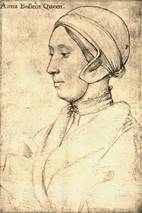
Karen L. Davies, et al facial recognition study argues that the Holbein sketch
below is Elizabeth Howard, not Anne Boleyn or others that have been suggested,
such as Sir Thomas Wyatt's wife or his mistress.
ELIZABETH HOWARD RADCLIFFE
Sophie Bacchus-Waterman's Elizabeth
Boleyn: The Life of the Queen's mother says she was buried in Lambeth in
1534.
MARY HOWARD
Sylvia Barbara Soberton's, Mary
Boleyn places Mary Howard in Anne Boleyyn's household at about age twelve
even though the usual age for a maid of honor was sixteen or older.
MURIEL HOWARD
Sophie Bacchus-Waterman's Elizabeth
Boleyn: The Life of the Queen's mother says she served Elizabeth of York. She
was the wife of John Grey (d. 9 Sept 1504). Their daughter Elizabeth was born
posthumously. Her last child by her second husband, Thomas Knyvett (d.1512) was
also posthumous. Muriel went into labor Dec. 14, 1512, contracted childbed
fever, and died at 1 AM Dec. 15. She made her will on Dec. 13. Her funeral was
Dec. 21 at Lambeth. Her seven female mourners were Elizabeth Boleyn, Elizabeth
Stafford Howard, Mary Bourchier, her three half-sisters (Anne de Vere, Anne
Bourchier, and Marjorie Bryan), and her mother-in-law, Eleanor Knyvett.
Fiftyt-two other mourners included gentlewomen Alys Denys and Margaret
Jerningham, d/o Mary Scrope. Many more details of the funeral are given in this
biography.
ANNE KNYVETT
Sophie Bacchus-Waterman's Elizabeth
Boleyn: The Life of the Queen's mother says Anne was in Queen Catherine's
household by 1514 and went to Wales in 1526 with Princess Mary.
BLANCHE MILBORNE
Rosemary Griggs, in Queen Elizabeth
I's Governess: The Real Kat Ashley reasons that Blanche retired from
Elizabeth Tudor's household c.1546. Her pension was sent to her at Troy House
in 1551/2. She is mentioned in her son's 1557 will and probably died c. 1559.
FRANCES NEWTON
Rosemary Griggs, in Queen
Elizabeth I's Governess: The Real Kat Ashley, suggests that Frances was
sponsored at court by Kat Astley
MARY NORRIS
James Taffe in Accounting for
Anne says Mary was in Anne of Cleves's household but left with Catherine Howard
(her cousin). She married Sir George Carew in the autumn of 1540 after his
first wife, Thomasine, died in Calais on 18 Dec. 1539 (while Anne of Cleves was
stranded there). Mary received from Catherine Howard a wedding gift of a pair
of crystal beads garnished with gold and others of "gold enameled blue and
set with stones." Rosemary Griggs, in Queen Elizabeth I's Governess:
The Real Kat Ashley, gives Mary's birthdate as c.1526 and suggests she was
first in service to Mary, Henry VIII's daughter, before
serving as a maid of honor to Jane Seymour, and that she received a gift of
jewels on Jane's death, and that she was a maid of honor to Anne of Cleves and
Catherine Howard and was probably the "Mary Norice" in Elizabeth
Tudor's household in 1536. Griggs dates her marriage to Sir George Carew to
late autumn 1540 and says they settled at Polstoe
Priory near Exeter.
ELIZABETH NORWICH (d. 1594)
According to Rosemary Griggs's Queen
Elizabeth I's Governess: The Real Kat Ashley the queen gave Elizabeth a gown
of purple velvet and sleeves of cloth of gold on the occasion of her wedding to
Sir Gawen Carew. Griggs gives his date of death as March 25, 1585.
JANE PARKER
Sylvia Barbara Soberton's, Mary
Boleyn says she married George Boleyn between October 4, 1524 and the end
of 1525.
BLANCHE PARRY
Rosemary Griggs, in Queen
Elizabeth I's Governess: The Real Kat Ashley gives Blanche's salary for a
half year at £5 in 1551/2 and suggests that if the Maundy Thursday miniature painted
by Lavina Teerlinck was of the ceremony in 1565, then it is Blanche shown
holding the queen's train.
ELEANOR PASTON
James Taffe in Accounting for
Anne says Eleanor, Jane Parker Boleyn, and Catherine St. John Edgecombe
were ladies of Anne of Cleves's privy chamber and signed a single document
testifying to a conversation with Anne of Cleves that confirmed her marriage to
the king had not been consummated. This may or may not have been fabricated to
secure an annulment.
JANE POPYNCOURT (d.1528+)
Steven Gunn, in Charles Brandon, Henry VIII's Closest Friend, cites W. C. Richardson's Mary
Tudor, The White Queen for the information that Mary, then duchess of
Suffolk, wrote to "Jeanne Popincourt" on June 20, 1528 to ask her to
intercede with Constable of France Montmorency about rewarding one of her
servants in France. According to the same source, a toy ship made of jet and
ornamental headgear were among the gifts Jane sent to Mary's children.
MARGARET POYNTZ (c.1505-1550)
Margaret lived at Barre's Court,
Gloucestershire and East Harptree, Somerset and may
have been visited at one of those locations by Kat Astley during the periods
when Kat was forbidden to see Elizabeth Tudor (1556-8). Rosemary Griggs, in Queen
Elizabeth I's Governess: The Real Kat Ashley, speculates that Kat sponsored
two of Margaret's daughters, Frances and Nazaret, at court.
MARY ROOS
James Taffe in Accounting for
Anne says that on death of Elizabeth of York a 1496 grant of 40 marks/year was
changed to an annuity for life. In 1535, as Lady Capell, Mary wrote to Cromwell
to say it had not been paid for two years. After she produced the patent in
1536 payments were restored and she was receiving them as late as 1540 from the
queen's dower lands
CATHERINE ST. JOHN
James Taffe in Accounting for
Anne says Catherine, Jane Boleyn, and Eleanor Paston were ladies of Anne of
Cleves's privy chamber and signed a single document testifying to a conversation
with Anne of Cleves that confirmed her marriage to the king had not been
consummated. This may or may not have been fabricated to secure an annulment.
KATHERINE
SPENCER (1477-October 1542)
According to Jan-Marie Knights in Anne Boleyn's First
Love: The Life of Henry Percy (which has an extensive bibliography but no
footnotes or index), she was the youngest daughter of Sir Robert Spencer and
related to Margaret Beaufort, Henry VII's mother. She
married Henry Percy, earl of Northumberland (January 14, 1478-May 19, 1527) by
1494, when she was present at jousts in honor of Prince Henry's creation as
duke of York. Her children were Margaret (late 1499 or early 1500-c.1540), Maud
(1501-d. yng) Henry (1502-January 30, 1537), Thomas
(c.1504-x. June 2, 1537), and Ingram (d.1538/9). Knights says Katherine's
husband died on or before May 13. The earl of Cumberland invited her to live at
Craven, but her son thought that would put her life in jeopardy. She wanted to
remain where she was or go to Lady Pickering, "kin to my lord her
son." Lady Pickering lived at Oswaldkirk, twenty
miles from York. The kinship came through a marriage into the Pickering family
in the 1400s. When the new earl heard that his mother proposed to travel to
Skipton, he objected because it would show a "marvelous inconstancy"
after refusing to live at Craven. Her dower house at Seamer, one of fifteen
manors that comprised her dower, became her main residence and she received
£413 6s 8d annually. When she was arrested in connection to her correspondence
with a rebel leader she was placed in the custody of Sir Brian Hastings at his
house near Doncaster. Knights says she died in 1541.but the details given from
her will are from one made in 1542. Her granddaughters Isabel (illegitimate
daughter of Sir Ingram) and Mary (daughter of Sir Thomas and wife of Sir
Francis Slingsby) were given numerous bequests and her gentlewomen were to
receive "the horses they rode, with saddles and trappers and various
clothes and wages." Isabel was named executrix although Stephen and Anne
Tempest of Brougham were to look after her. Isabel married their son Henry in 1544.
ANN STANHOPE
James Taffe in Accounting for
Anne names Ann as a lady in waiting to Anne of Cleves. She left court in
spring 1540 to give birth to a daughter, Margaret. The queen visited her and
gave rewards to the baby's nurse and to minstrels who performed during her
visit.
MARY TALBOT
(c.1504-April 16, 1572)
According to Jan-Marie Knights in Anne Boleyn's First
Love: The Life of Henry Percy (which has an extensive bibliography but no
footnotes or index), Mary was not betrothed to Henry Percy in 1516, although
negotiations for a marriage had taken place between their fathers. Knights
states it is unknown if the young people met at this time, despite the later
story that they had and had disliked each other on sight. An indenture between
Shrewsbury and Thomas, baron Dacre of Gilsland for Mary to marry his son,
William, Lord Greystoke (b. 19 April 1500), is dated December 1, 1517. In
September 1523, correspondence between Wolsey and the earl of Surrey indicates
that a betrothal between Mary and Henry Percy was once again under discussion.
By that date, Lord Greystoke had married Elizabeth Talbot, Mary's sister. A
letter dated December 17, from the earl of Shrewsbury to Lord Dacre, mentions
his hope that the wedding would take place early in 1524. Knights states that it
does not appear to have taken place in late August 1526. At that time Henry
Percy was still serving in Cardinal Wolsey's household and was still estranged
from his father. When the earl of Northumberland died in May 1527, his accounts
revealed that Mary's dowry of 2500 marks had not been paid. Records from 1526-7
show wages paid to Mary's two gentlewomen and groom and value her wardrobe at
£40. In September 1528, Mary's husband wrote to Cardinal Wolsey to complain
that she had "vilified" him and was spreading "malicious
imaginations and untruths" to her
sister, Lady Dacre, and her father. After Shrewsbury claimed Mary feared being
poisoned, Northumberland offered to send her back to him with a reasonable
allowance and never come into her company again. The duke of Norfolk thought
Mary might have epilepsy. Knights says that Mary appears to have been persuaded
to return to her husband in 1531 because she was involved, together with
Northumberland and his brother, Sir Ingram Percy, in alienating several
properties in Kent on the first of April of that year. That September, the earl
was at Warkworth and was paying around £1,128 a year
to support his brothers, uncle, mother, and wife. In July 1532, Mary told her
father that Northumberland had abstained from her company for the past two
years and that, during a quarrel, he had claimed not to be her husband because
of a pre-contract with Anne Boleyn. As a result, Northumberland was called
before the Privy Council and swore that there had been no pre-contract. Knights
dates Mary's final break with her husband at around September 8, 1534. When
Northumberland signed over his estate to the king in February 1536, provision
was made for "lands worth £500, to grant a jointure for life to any wife
of a yearly value of 500 marks" but Mary's father had to lobby for that
provision to be included. On November 1, Shrewsbury wrote to Northumberland
that Mary had been with him for "two years past on Our Lady of the
Nativity last" and reminded him that he had promised 200 marks a year for
Mary's upkeep. He had received "nothing but the stuff your lordship sent
her" and demanded that 300 marks be given to the bearer of his letter.
Another letter from Shrewsbury, dated February 1, 1537 and addressed to
Cromwell, stated Mary had been with him "two years from Christmas
last" and still had not received any of the money promised for her
maintenance. When Northumberland died, he was still in debt to "my lady
his wife for her living, behind two and a half years at Easter last 500
marks." On May 1538 (not 1542) Mary was at Greenwich to petition the king to
sue for her dower. Knights quotes an "eyewitness account" but does
not give her source.
ANNE TEMPEST
Sophie Bacchus-Waterman's Elizabeth
Boleyn: The Life of the Queen's mother says Anne Tempest was not at court
until 1517 at the earliest, when she was at least 12. She had married by June
1520.
ELIZABETH TYLNEY
(d.1497)
Sophie Bacchus-Waterman's Elizabeth
Boleyn: The Life of the Queen's mother concludes that the poem, Garland
or Chapelet of Laurel was written years later
about a visit by John Skelton to Sheriff Hutton in May 1495 because the
countess of Surrey (Elizabeth Tylney) was his patron before he became Prince
Henry's tutor. The women present therefore were Elizabeth Tylney Howard,
Elizabeth Howard, who was a teenager, and Muriel Howard, age 10, Anne Bourcher,
the countess's daughter by her first marriage, who married Thomas Fiennes,
baron Dacre in 1492, Margery Wentworth, who became Jane Seymour's mother,
Margaret [Brewes] Tylney, sister-in-law of Agnes
Tylney, Jane Blennerhassett, daughter of Sir Thomas, Isabel Pennell, Margaret
Tylney's niece, Margaret Hussey [Margaret Blount, Lady Hussey?], Gertrude
Statham, and Isabel Knight.
BRIDGET WILTSHIRE
Sylvia Barbara Soberton, Mary
Boleyn says Sir Richard Wingfield died in 1524 on a mission to Charles V's
court in Toledo and Sir Nicholas Harvey died in August 1532 of the plague.
ELIZABETH WOOD
Sophie Bacchus-Waterman's Elizabeth
Boleyn: The Life of the Queen's mother says Elizabeth Wood was not Lady
Boleyn until 1515 or 1516 and cites C.
Norton The Boleyn Women as her source..
LISTS OF WOMEN AT COURT:
Household of Princess Mary, later
Queen of France
(from Sylvia Barbara Soberton, Mary
Boleyn)
Mary Boleyn/Marie Boulonna
M. Wotton
Lady Elizabeth Grey
Elizabeth Ferrys
Anne Devereux
Grey of Wilton
Joan Berners (Bourchier)
Alys Denys, chamberer
Anne Jerningham, chamberer
Anne Boleyn's household:
Possible ID for Mistress Marshall,
Mistress of Maids
According to Sophie
Bacchus-Waterman's Elizabeth Boleyn: The Life of the Queen's mother
William Marshall's will (written 8 July
1531;proved 6 Feb 1532) gave Elizabeth
Howard Boleyn "oversight and governance" of his daughter Elizabeth
and of her marriage. At that time, according to online genealogies, his
daughter was the widow of John Brocas of Horton (1476-1518) and had two
children, Robert (1510-1558) and Elizabeth (1515-1581), which makes it seem
very odd that she would be in need of "oversight and governance" from
someone who was not a family member. Bacchus-Waterman suggests William's wife,
Mary Marshall, was Mistress Marshall, Mother of Maids under Anne Boleyn
(1534-1536). For more information see Bacchus-Waterman's article: "'Mrs.
Marshall': The Identity of the Mother of Maids in Anne Boleyn's Household"
The Court Historian, vol. 29, no.3, 2024, pp. 211-218
James Taffe in Accounting for
Anne identifies the following gentlewomen who accompanied Anne of Cleves to
England:
Swartzenbroch
Brempt
Ossenbruch
Wyllyk
Lady Wissem, howmestrinne
(Mother of Maids?)
Loe (or Loew)—"Mother
Lowe" was from Cleves and is recorded on May 22, 1540 as being one of
several "Dutch maids" who wanted to return home. While waiting for
the king's permission, they were housed in the Tower of London, which
reportedly terrified Mother Lowe. Sir William Paget was assigned to escort them
home and leave to depart was granted by June 1540 but the final license was
approved by Catherine Howard. A June 24 1540 reference to Catherine Malecrode
and Gertrude Wyllyk (wife of Otto? If so d. before
1552) mentions Anne Joscelyn, chamberer, Elizabeth Rastell, chamberer, and a
Mother of Maids who was paid £20/year. Ellen Turpin, laundress, received
40s./quarter and was mentioned in Anne's will. Not listed in April 1540 were
Catherine Howard, Catherine Carey (cousin of Catherine Howard), and Mary Norris
(cousin of Catherine Howard). They were replaced by Margaret Garneys and Damascin (or Katherine) Stradling. In 1552: Count Von
Waldeck tried to discharge Jasper Brockhouse, cofferer, and his wife Gertrude
but Anne refused; they buried their daughter Anne at Bletchingly
in the spring of 1553; in 1556 the Duke of Cleves claimed that Gertrude had
driven Anne of Cleves mad "by her marvellous
impostures and incantations."
WOMEN WHO WOULD HAVE BEEN
RESEARCHED AND INCLUDED HAD I KNOWN ABOUT THEM SOONER
ELIZABETH ASTLEY
Rosemary Griggs, in Queen
Elizabeth I's Governess: The Real Kat Ashley mentions her as the sister of John
Astley, Kat's husband, and says she was a servant of Lady Jane Grey when Lady
Jane was living in the household of Lord Admiral Thomas Seymour. She went with
Lady Jane to Chelsea when he married Katherine Parr.
ELIZABETH CHAMPERNOWNE (d. 1594)
Rosemary Griggs, in Queen
Elizabeth I's Governess: The Real Kat Ashley identifies Elizabeth as one of
Kat's sisters. In 1561, when Kat's husband was sent from court for advocating
the suit of the King of Sweden, Kat also left court for six weeks. She stayed at
least part of that time with Elizabeth, a widow who lived at the Slade, near Cornwood, Devon, with her son, Philip Cole. Her first
husband was William Cole. Her second was Archdeacon John Pollard (d.1560).
ALYS DENYS
Sophie Bacchus-Waterman's Elizabeth
Boleyn: The Life of the Queen's mother identifies Alys as a lady of the
queen's household in Catherine of Aragon's coronation procession and says she
served Claude of France along with Mary Boleyn and was a mourner at funeral of
Murial Howard in 1512.
ISABELLA OF AUSTRIA (July 18, 1501-January 19,
1526)
According to Jan-Marie Knights in Anne
Boleyn's First Love: The Life of Henry Percy (which has an extensive
bibliography but no footnotes or index), she visited England in 1523, together
with her husband, the exiled King Christian II of Denmark and Sweden
(1481-1559), and a retinue including their three children, four gentlewomen,
and forty other retainers. They hoped to find support for Christian's
restoration to the throne. Arriving at Dover on June 15, they were escorted to
Greenwich by the earl of Devon and the bishops of Exeter and Rochester. They
were entertained daily at court but housed at Bath Place until they left in the
first week of July. According to Wikipedia, Isabella (Isabel/Elizabeth) was the
daughter of King Philip I and Queen Joanna of Castile (Katherine of Aragon's
sister) and the sister of Charles V. She was raised at the court of Archduchess
Margaret at Mechlin, where she received an excellent education. She married in
1514 and was queen consort of Denmark from 1515-1523 and of Sweden from
1520-1521. After her husband was deposed she traveled throughout Europe to
advocate for his restoration. The children with her in England were John,
Dorothea, and Christina (1523-1590). Wikipedia says they stayed at Hampton
Court during their visit to England. Portraits: c. 1515 by the Master of the
Legend of the Magdalen; by Jan Gosseart, tentatively identified as Isabella.
THOMASINE POLLARD
Rosemary Griggs, in Queen
Elizabeth I's Governess: The Real Kat Ashley reports that Thomasine, the daughter of Sir Lewis Pollard of King's Nympton, Devon (d.1526), a judge of the Common Pleas, and
Anne Hext (1468-1561), accompanied her husband, Sir George Carew (c.1502-1545),
when he took up his post as Captain of Rysbank Castle
in Calais in 1539. By December 5, 1539, when Sir George took part in a joust at
Calais during the entertainments for Anne of Cleves, Thomasine was already ill.
She died on December 18.
MARGARET POYNTZ
Margaret was the daughter of Sir
Robert Poyntz of Iron Acton (d.1520). A footnote in Rosemary Griggs's Queen
Elizabeth I's Governess: The Real Kat Ashley records that in his will, he
left Margaret a marriage portion of 300 marks and another 50 marks for apparel,
but if she did not agree to a match arranged by her uncle and brother, she
would lose the 50 marks. Later in the will, he left her another 50 marks with no
conditions. She is probably the second Margaret Pointz attending the Field of
Cloth of Gold as a maid of honor in 1520. Griggs says she married Sir John St.
Loe, Constable of Portbury and of Thornbury Castle. It is doubtful he was Sir
John St. Loe of Sutton Court, Chew Magna, Somerset (c.1479-December 1558),
although that John St. Loe also had a wife named Margaret, because they had
children, including Sir William (1518-1565), Elizabeth, and Edward
(c.1520-1578) born before 1520. Margaret St. Loe of Sutton Court was still
living in 1559.
MAGDALEN
ROCHESTER (b. c. 1505)
According
to Jan-Marie Knights in Anne Boleyn's First Love: The Life of Henry Percy (which
has an extensive bibliography but no footnotes or index), Magdalen or Magdalene
Rochester was rescued from drowning by Charles Brandon (later duke of Suffolk),
who afterward adopted her. In 1513, Magdalen accompanied Brandon's six-year-old
daughter, Anne, to the court of Margaret of Savoy, where they were intended to
remain. In May 1515, after Brandon's marriage to Mary Tudor, he wrote to
Margaret that Mary desired Anne's presence. She returned to England but Magdalen
remained with the archduchess. Steven Gunn, however, in Charles Brandon:
Henry VIII's Closest Friend, citing W. C.
Richardson's Mary Tudor, the White Queen, states that Brandon was
obliged to recall from Margaret's court to England "the girl he had
adopted and placed there as companion to his daughter Anne."
JANE STAFFORD
Sylvia Barbara Soberton's, Mary
Boleyn identifies Jane as the sister of William Stafford, who married Mary
Boleyn and then Dorothy Stafford. Jane and her husband, William Willms, went
into exile with William and Dorothy. On February 24, 1556, Jane married
Maximilian Celsus, an Italian preacher.